Over the last 16 years I’ve leaned on Kent Neuro as a place to continue my rehabilitation and share experiences. I started off with a Pilates class in the old Centre and then once the new Centre was built I began to explore the other beneficial therapies on offer. Even now I see improvements in what I am able to do physically and I’m so grateful.
During the summer of 2004, whilst in the throes of relocating to Canterbury from North Wales, I experienced the first symptoms of what would eventually be diagnosed as Multiple Sclerosis. Tingling and numbness in my right leg that I ignored for the most part as I had a toddler and an eight month old – there wasn’t much time to worry about anything else! When the numbness increased to weakness and impacted my walking I knew something was seriously wrong. After a lot of chasing appointments, asking to be seen more quickly, one lovely doctor finally sent me to A&E and requested an urgent MRI. I remember the conversation with the neurologist; “it could be lots of things, a virus… as long as it’s not MS…”
The diagnosis was a huge shock, but I was given a steroid drip and over the next few days in hospital I regained my ability to walk without dragging my leg and my sensation almost completely returned. This was what MS was like for me for the first few years; every few months a fairly severe relapse, a short stay in hospital, steroids, then returning home to ‘almost normal’. I didn’t really engage with the diagnosis. I didn’t want to accept help other than from family, as being in my late 20s I was convinced I was ‘too young’ to contemplate life with a disability. I was a professional soprano singer and taught music and dance to young children at a local independent school. I had a wide range of relapses, ranging from losing the use of my fingers for tasks such as doing up buttons, partial face drop and a reduced ability to control eye movement, painful tingling in my head and upper back, and the most frequent visitor, leg numbness and weakness. I remember having to look to see where my legs were under the table before standing up, as there was no guarantee they’d stayed where I’d left them when I sat down, which meant for some embarrassing attempts to move after a meal!
Over the years I tried using a couple of different Disease Modifying Therapies, but I didn’t find they made much difference to the course of my relapses, so when I made the decision to have another baby I stopped. A lot of research went into the decision to increase the size of my family, I knew the chances of a severe relapse following delivery were high, but I’d had so many serious relapses and returned to ‘almost normal’ after a couple of weeks in hospital. Therefore it was a calculated risk with the full support of my family who had agreed to help in the potentially difficult first few weeks and months. Most women experience a fairly relapse-free pregnancy but I didn’t follow the trend and needed several courses of steroids over the nine months for optic neuritis and loss of sensation and strength in my lower limbs. I still refused to use walking aids, instead choosing to hold the shoulders or heads of my six and four year old boys when moving around outside. They essentially became young carers, standing on chairs to hang washing on the line, stripping the beds and loading bedding into the washing machine or tumble drier.
Following my daughter’s birth in September 2008 I suffered a catastrophic relapse that wiped out all sensation and movement from my ribs downwards.
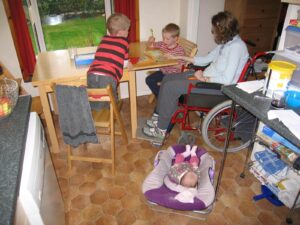
My last visit home for a while
When she was ten days old I was taken to hospital by ambulance and stayed there for the next four months as an inpatient, first at the K&C and then at the Neuro Rehab unit which was at Buckland Hospital in Dover at that time. I started off being able to return home in a wheelchair for weekend visits but after a couple of those the relapse had become so severe they were impossible as I didn’t have the equipment in place at home to manage and transferring in and out of the car was unsafe.
I lost the ability to sit unsupported, using my phone or a computer to type was tricky as more of my body was affected. I remember being jealous of people sitting on a sofa, or leaning against a wall whilst standing, things I didn’t think would be possible for me ever again. My mum brought my baby girl in once a week and the boys came in with their dad occasionally, but I wanted them to keep to their routine and see as little of my life in hospital as possible. I remember at Halloween the children came to visit with my mum, dressed in their spooky outfits having made me some themed cupcakes so I didn’t miss out. My eldest son, aged six, was pretending to cast spells and suddenly burst out with “hocus pocus, make Mummy’s legs all better”, tapping my leg with his plastic trident. There was a shocked silence as my mum and I worked out how to respond. It makes me emotional writing this now, as the boys believed I was in hospital to ‘get better’ and would come home once I had recovered. We gently explained that the doctors were working really hard but we weren’t sure if my legs would be able to ‘get better’. It was a tough time.
I received daily intensive physiotherapy and occupational therapy. I was in awe of these professionals who worked day after day with humour and so much knowledge, to begin to make tiny improvements in my mobility. They were taskmasters though, pushing me to my physical and mental limits, but this was exactly what I needed. I wanted to reach my potential in terms of recovery, but at the same time I gradually accepted the prospect of a very different future from the one I’d known previously. Focussing on the things I could do with my children, such as reading to them and playing board games, rather than on the things I wasn’t able to do anymore.
It seemed as though once I’d made peace with this new me, I could allow myself to really focus on smaller elements of physical improvement, rather than constantly wishing for the ‘big ones’. Walking again wasn’t the end goal.
Singing, one of the most fundamental elements of who I am, was something I had to approach differently as the lack of core stability and strength seriously impacted my vocal technique. During one physio session when I was strapped into a standing frame designed to remind your body what it feels like to stand upright, the physios asked me to sing. I was nervous and reluctant at first but then took the plunge and sang ‘Twinkle, Twinkle, Little Star’ whilst they kept out of sight in their office. It felt so empowering to have the space in my lungs to properly project after being scrunched up in the wheelchair so I made the most of the opportunity, and in doing so, reduced one of the physios to tears!
One morning, whilst in the hoist used to transfer me from my chair to my bed, a nurse spotted my leg moving as I was suspended in mid air. I assumed it was momentum from the movement of the hoist at first, then realised I was able to make it move again. This was a huge turning point and gave me so much hope. We gradually built on this over the weeks, making more tiny breakthroughs, until I was able to regain enough sitting balance to transfer safely and make weekend visits home possible again, with hospital equipment in place.
Eventually I was ready to attempt one of the scariest parts of my recovery, an assisted stand. To begin with I played a passive role in the process whilst five professionals, one on each leg, one each side of my torso and one in front (to stop me face planting into the floor) guided me from a seated position into standing. Until this point I’d only used standing frames, where you’re strapped in and at the push of a button gradually pulled up to standing. Without the safety blanket of the machinery around me I was petrified of falling, but each time I became more and more stable and the number of professionals required to assist me reduced. In my hospital discharge meeting, my goal was to be able to stand at a bar whilst another chair or a commode was moved underneath me. The plan was that I’d be home after Christmas to be reunited permanently with my children.
During a physio session in early December, I was standing holding onto the bar in the hospital gym when one of the physios asked me to move my leg forward. I moved it forward, then back. Then the other. She called her colleague, they wheeled me in my chair between the parallel bars and we repeated the stand, but this time I held the two bars, one in each hand. With one physio guiding my feet and the other pushing the chair behind me I took my first incredibly slow, faltering steps. I couldn’t believe it! I think we all cried – this was something I hadn’t dared hope would happen ever again. I didn’t sleep much that night! This amazing breakthrough brought a dilemma: I was asked whether I wanted to stick to my original discharge date, or whether I’d consider staying in hospital for an extra month to see just how much further I could progress with my recovery. I opted to stay. I wanted to return home knowing that I’d done everything possible to increase my mobility. I knew my children needed a mummy who had worked as hard as possible to get back to them in the strongest condition I could achieve.
30 January 2009: D Day – Discharge Day
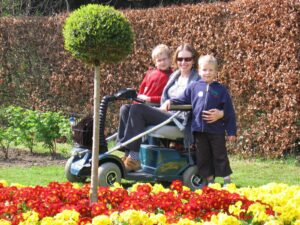
Family days out required a little more planning
I was wheeled from the place I’d come to call my second home and went back to a very different life, but one full of hope and possibility. During my final month as an inpatient my progress had snowballed as my muscle strength had increased rapidly with so much input. I had learned to use a walking frame and was able to walk short distances inside and outside. I remember one of the first things I did after I’d been home for a few days was go to Sainsbury’s with my mum and my baby, walking the short distance from the car to the coffee shop with my walker. I felt on top of the world sitting there with my favourite latte order and my baby on my lap, wondering why nobody was cheering! Such a simple pleasure I’d taken for granted before, not now. I could use stairs with supervision which meant I was able to access the first floor in my house, somewhere I hadn’t been since I’d left the house to give birth at the beginning of September. The hospital bed I’d been using in the living room during my weekend visits was collected, as I could make the trip up and down the stairs at the start and end of each day, this felt like such a gigantic achievement and it was wonderful to be able to sleep in my own bed. I had visits from the community physios each week to make sure I didn’t plateau and gradually transitioned from my walking frame to walking with a wheeled walker (hello stomach muscles) then crutches, then one crutch, then a stick. Each time I changed walking aides I wondered if they’d ever feel ‘comfortable’ and ‘safe’ but they always did, in time.
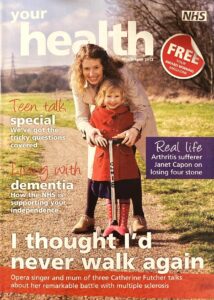
I was prescribed Tysabri, a drug administered every four weeks, at first intravenously but now, 16 years later, sub-cutaneously. For me this treatment has been my wonder drug and has kept further relapses at bay. My success story on the drug meant I was featured in two medical journals and on the front cover of Your Health magazine in 2012.
My experience during that dark period of my life has impacted me hugely, life changing revelations that stay with me to this day. I’m utterly humbled by the human body and what it can do.
I’m in awe of the NHS: the physiotherapists and my incredible occupational therapist at Buckland were magicians in my eyes. So grateful for the strength and support of my family, particularly my parents, who put their lives on hold to help me and my children manage during not only those four months whilst I was in hospital, but for the whole year, as my mum moved in to support me in looking after my children. My daughter was too little for me to look after on my own, safely, without support. The power of friendship, my closest friends who visited and brought so much light to those dreary evenings in my hospital bed. The realisation I came to, that accepting your disability is not ‘giving in’, I attribute to the inspiring people I met as my fellow inpatients in hospital and in the years since at the KMSTC. They have enriched my life with so much joy and good humour, with a shared experience of being in this ‘club’ that having MS makes you a member of. I’d missed out on it during those first few years of my diagnosis, I’m making up for it now.
Over the last 16 years I’ve leaned on KMSTC as a place to continue my rehabilitation and share experiences. I started off with a Pilates class in the old Centre and then once the new Centre was built I began to explore the other beneficial therapies on offer. Even now I see improvements in what I am able to do physically and I’m so grateful.
Getting back to work and off many of the benefits I was on was hugely important and I gradually rebuilt my career as a singing teacher and performer. I teach at St. Edmund’s School, at Canterbury Christ Church University and run my own private singing practice from my home. This has enabled me to support the Centre through music, featuring as the soloist in two concerts at Canterbury Cathedral to raise money for the grand rebuilding project ten years ago, then raising over £1,500 from two concerts I presented on YouTube during the pandemic.
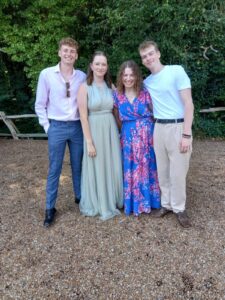
Hopefully you will have already seen the email advertising the concert I have organised at The Great Hall, Kent College on Sunday 18 May. This gala evening features me, fellow MS member and professional musician Naomi Honour Adams as well as vocal ensembles from three local schools I have a connection with; Kent College, Simon Langton Girls’ Grammar School and St. Edmund’s Junior School. Two of my three musically talented children will also take part: my daughter, now 16, with a passion for the performing arts, is joining me in a duet as well as singing with her school group, and the younger of my sons, now 21 currently training in professional music performance and production will also perform.
It would mean so much if you could show your support by buying a ticket and joining us for what promises to be an entertaining and uplifting evening, championing strength and resilience through the power of music and community.
To provide the best experiences, we use technologies like cookies to store and/or access device information. Consenting to these technologies will allow us to process data such as browsing behaviour or unique IDs on this site. Not consenting or withdrawing consent, may adversely affect certain features and functions.
Functional Always active
The technical storage or access is strictly necessary for the legitimate purpose of enabling the use of a specific service explicitly requested by the subscriber or user, or for the sole purpose of carrying out the transmission of a communication over an electronic communications network.
Preferences
The technical storage or access is necessary for the legitimate purpose of storing preferences that are not requested by the subscriber or user.
Statistics
The technical storage or access that is used exclusively for statistical purposes.The technical storage or access that is used exclusively for anonymous statistical purposes. Without a subpoena, voluntary compliance on the part of your Internet Service Provider, or additional records from a third party, information stored or retrieved for this purpose alone cannot usually be used to identify you.
Marketing
The technical storage or access is required to create user profiles to send advertising, or to track the user on a website or across several websites for similar marketing purposes.


My last visit home for a while